

Much of my coaching involves helping clients respond to colleagues who engage in high-level finger-pointing, creating drama and the sense that you must always look over your shoulder. It is draining, distracting, and destructive. Certainly not conducive to valuable, collaborative relationships.
One model that helps explain these patterns is the Karpman Drama Triangle, developed by psychiatrist Stephen Karpman in 1968. Its components and effects will feel familiar to many of us.
The model explores how people interact through three roles, with implications for responsibility, power, and personal boundaries. I find it fascinating because I often see these patterns at work when the people involved do not realize what is happening.
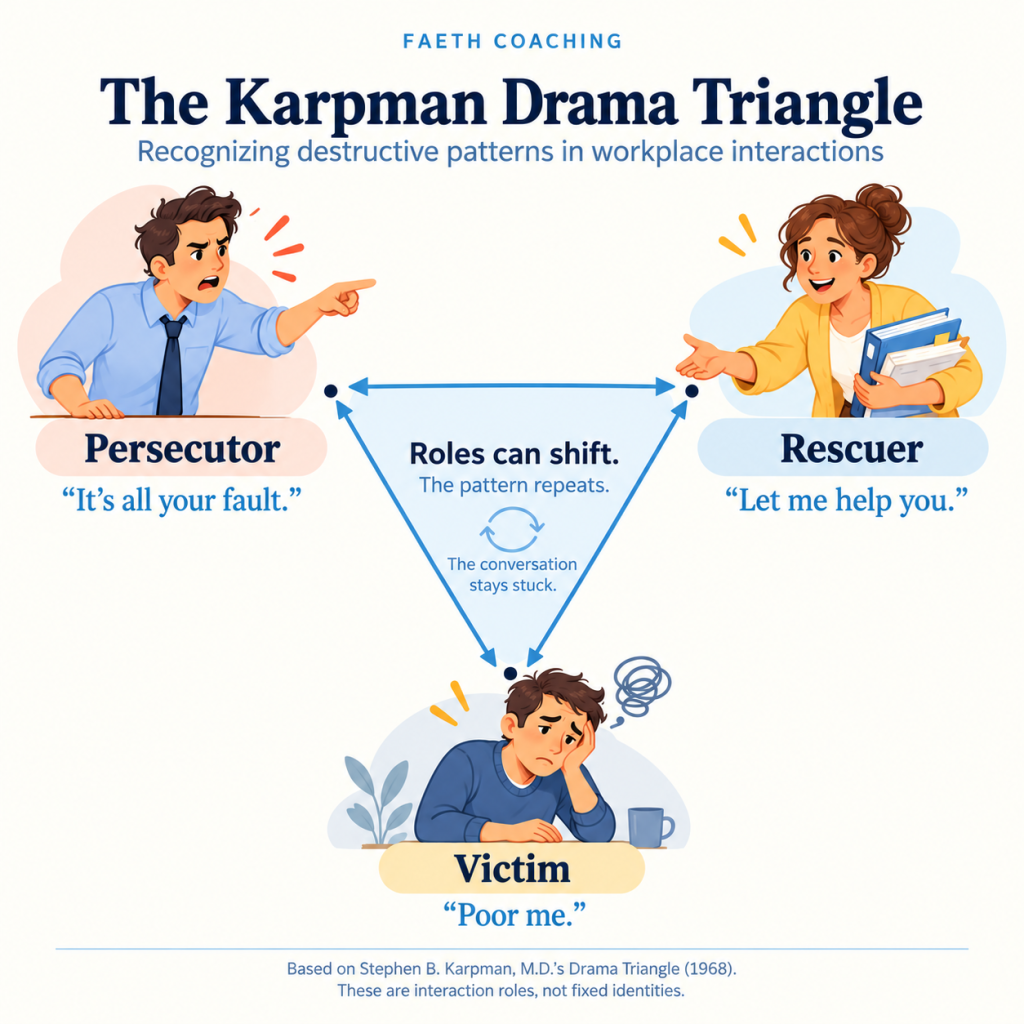
These are roles people can slip into during an interaction, not fixed personality types. A person may move between roles within the same conversation.
In this role, a person feels helpless, hopeless, or powerless and struggles to see how they can make decisions or solve problems. Their thinking might sound like: “I just give up. I’m not okay, and everybody else is.”
Here, “Victim” describes a role within the model. It does not mean that someone experiencing genuine mistreatment is responsible for that mistreatment.
This is the enabling role, in which a person feels guilty if they do not come to the rescue. By taking over, they can unintentionally reinforce the other person’s sense of helplessness.
Their thinking might sound like: “You need my help. I will fix this for you.”
The issue is not helping someone. It is taking responsibility for a problem in a way that prevents the other person from developing their own ability to address it.
This role involves controlling, blaming, and criticizing. A person in this position may act superior or use threats and bullying to maintain control.
Their thinking might sound like: “This is your fault. Do what I tell you.”
None of these roles creates a healthy basis for collaboration. People can move between them, keeping the drama going until someone begins to communicate and respond differently.
Each role offers a different starting point for changing the pattern:
Each role has its own relationship to power and responsibility. Each person can help change the interaction by communicating clearly and taking responsibility for their own actions.
At the same time, the roles can shift. The Victim may become the Rescuer; the Persecutor may become the Victim. Because of this movement, I believe an important way out is to focus on what you want and the outcome you hope to achieve, while recognizing what is yours to address.
Be honest. Be succinct. Be fair.
Moving beyond the constant shifting of roles requires honest communication: bringing clarity and directness to the conversation, especially when we feel uncomfortable or worried. It also means respecting boundaries and allowing others to take responsibility for their decisions.
This is a brief, high-level description of the Triangle. In your next conversation, think about the role you may be playing and the roles others may be taking. What could you do differently to make the conversation more productive?
Remember, we communicate not to win, but to reach an outcome that offers the most benefit to all.
Whether you’re stepping into a broader role, leading a growing team or navigating complex organizational dynamics, a conversation with Frank is a good place to start.